

How to Check Boiler Pressure (and What to Do If It's Wrong)
Your radiators are cold, the hot water has gone, and someone in the house says "check the boiler pressure". Where do you even look?
Learning how to check boiler pressure takes about two minutes, needs no tools, and is the first thing I look at on a heating call-out. I am Eric, a Gas Safe registered engineer (577508) with over 18 years in the trade, including my years with British Gas, and now running Trusted Boilers across Croydon, Sutton, Wimbledon and the rest of South London.
In this guide I'll show you where to find the gauge, what the numbers mean, how to top the pressure up safely, and the point where you should stop and call a Gas Safe engineer.
How do you check your boiler pressure?
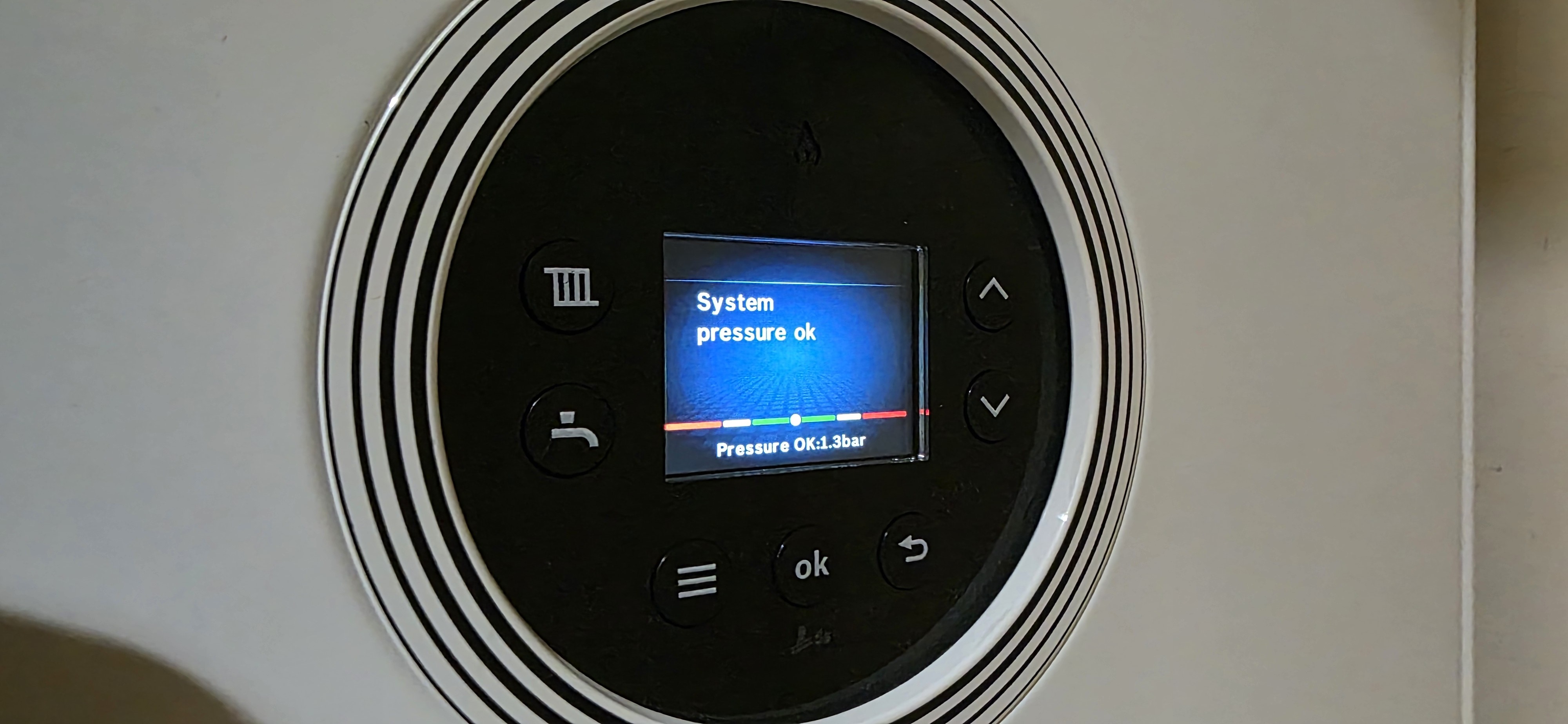
Look for the pressure gauge on the front of your boiler. It is either a small dial with a needle or a digital reading on the display. With the heating off and the boiler cold, the reading should sit between 1 and 1.5 bar. Below 1 bar is too low.
That is the short answer. Here is how to do it properly:
- Make sure the heating has been off for a while, so the water has cooled down. A hot system reads higher than a cold one.
- Find the gauge. On most combi boilers it is on the front panel, often behind a flap. If you can't see one, check your manual or look underneath the boiler.
- Read the needle or number. Many dials have a green zone (usually the safe range) and a red zone.
- Note the reading, or take a photo. If you ever call us, a photo of the gauge helps a lot.
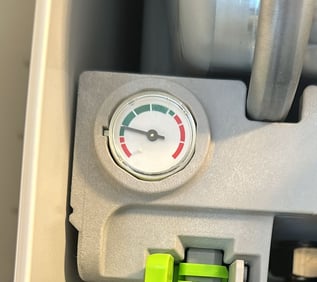
In the green zone: about 1 bar on a cold combi, which is where most should sit. It will rise a little when the heating is on.
What should boiler pressure be?
For most home boilers, the right pressure is 1 to 1.5 bar when the system is cold. Both British Gas and Vaillant give this range in their own customer guidance. On the cold combis I see, the needle usually sits at about 1 bar. Your boiler's manual is the final word, because some models differ.
Here is how to read your gauge:
| Reading (cold system) | What it means | What to do |
|---|---|---|
| Below 1 bar | Too low. The boiler may not fire up or may lock out. | Top it up using the steps below. |
| 1 to 1.5 bar | Normal. | Nothing to do. |
| 1.5 to 2 bar | A little high, but acceptable on some systems. | Keep an eye on it. Check again once it has cooled. |
| Above 2 bar (cold) | Too high. | Do not ignore it. See the section on high pressure. |
| Above 2.5 bar (hot) | Too high even when running. Vaillant advises avoiding pressure above 2.5 bar. | Turn the boiler off and call a Gas Safe engineer. |
A small rise on the gauge when the heating is running is normal, because water expands as it heats up. It should settle back down when the system cools. If it climbs sharply every time the heating comes on, that is a sign something is wrong (more on that below).
Is low boiler pressure dangerous?
Low boiler pressure is not normally dangerous in itself. Modern boilers have a safety cut-out, so a low reading usually just means no heating or hot water until it is put right.
Pressure can also drift down gradually over time without a leak or a fault, so needing an occasional top-up is not by itself a sign of a problem. That is why it pays to get into the habit of checking the gauge. What matters is how fast it drops and how often.
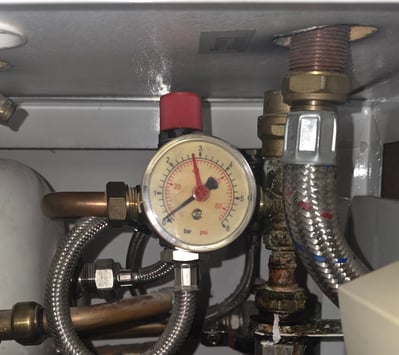
Too low: the black needle has dropped to almost 0 bar. The red hand is only a marker, so read the black needle. At this level the boiler will usually lock out. If it keeps dropping, get it checked.
If the pressure drops quickly or repeatedly, the possible reasons include:
- A leak somewhere in the system, from a radiator valve, a pipe joint or the boiler itself.
- Recently bleeding a radiator, which lets water out of the system.
- A fault with the expansion vessel or the pressure relief valve.
If you top up once, for example after bleeding a radiator, and it holds, you're fine. Call a Gas Safe engineer if the pressure falls quickly, keeps falling again within days or after topping up, or you can see water or damp around the boiler, pipes or radiators. Our guide to why your boiler keeps losing pressure covers the usual suspects in detail.
A real call-out: Worcester Bosch with a flashing red reset button
A customer called Trusted Boilers because their Worcester Bosch boiler was showing a flashing red reset button. The boiler would reset, but it would not stay on for long before going back to the failed state.
No leak was found on this call-out. The pressure gauge was showing zero. Once the pressure was topped up and the boiler reset, it worked correctly. This boiler had an integral filling loop in the form of a blue lever, and that is what was used to add the pressure.
If your boiler keeps resetting and failing, check the pressure gauge first. It takes seconds, and it can tell you a lot.
A second real call-out: Baxi system boiler needing top-ups every day or two
A customer's Baxi system boiler needed repeated pressure top-ups, approximately every day or two. On arrival, the boiler was showing low pressure.
The expansion vessel was investigated and found to be empty, meaning it had lost its charge. The charge was reset, and the excess water was pumped out of the system so it could expand correctly. The loss of water had activated the pressure relief valve (PRV), so it had to be removed and cleaned. In some cases the PRV needs to be replaced. The pressure was then reset using the filling loop and the system was reinstated.
Work on an expansion vessel or a pressure relief valve is for a Gas Safe engineer. Please don't attempt it yourself.
The takeaway: needing a top-up every day or two is not normal drift. It is a sign to get a Gas Safe engineer to check the system.
How do you top up (repressurise) your boiler?
Most modern combi boilers have a filling loop, which is a flexible braided pipe with a valve at each end. It lets mains water into the heating system. Always check your own manual first, as the setup varies between models.
Some boilers, for example the Worcester Bosch I describe in the call-out above, have an integral filling loop instead. That is a built-in lever (blue in that case) rather than a braided hose. If your boiler has one, check your manual for the right method.
Follow these steps if you have a braided filling loop with a valve at each end:
- Switch the boiler off and let it cool down.
- Find the filling loop under the boiler and check it is connected securely at both ends.
- Open one valve fully, then open the other gradually, a little at a time. You should hear water flowing.
- Watch the gauge closely. Filling can take anywhere from a few seconds to a minute and a half, depending on the size of the property, so keep watching. Stop when it reaches 1 to 1.5 bar.
- Close both valves, one after the other, and make sure they are fully shut.
- Switch the boiler back on. If it has locked out, it may show as a fault code or a red light, depending on the brand. Common codes include F75 on Vaillant, E119 or E118 on Baxi, and F1 on Ideal. Check your manual for what yours means, then press the reset button once.
- Return the filling loop to its original state, as you found it, with both valves fully closed.
Mistakes to avoid when topping up
- Don't leave the filling loop open. This is one of the easiest ways to overfill a system, and it can push the pressure well above the normal range.
- Don't top up with the boiler hot. The reading will be misleading.
- Don't keep topping up again and again without finding out why. An occasional top-up is not by itself a problem, but if you need to do it every few days, get an engineer to check it.
- Don't open or remove the boiler casing. Only a Gas Safe registered engineer should do that.
What if your boiler pressure is too high?
High pressure usually has a cause you can't fix with a tool, so this is where DIY ends. If the gauge reads well above 2 bar when cold, or climbs above 2.5 bar when the heating is on, switch the boiler off and call a Gas Safe engineer.
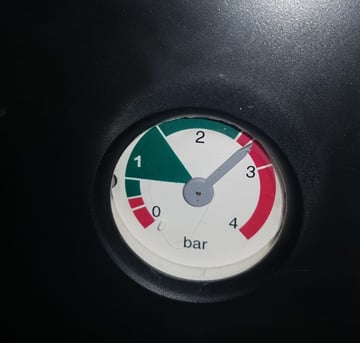
Too high: the needle is in the red zone at nearly 3 bar. If pressure stays this high, don't keep draining it. Get a Gas Safe engineer to check the expansion vessel and pressure relief valve.
Possible causes include an overfilled system, a filling loop that has been left open, or a failed expansion vessel. If you see water dripping from a small copper pipe outside your home, that may be the pressure relief valve discharging. It means the safety valve has operated, and it needs checking by a Gas Safe engineer.
Bleeding a radiator is sometimes suggested to reduce pressure, but it is not a fix for a fault, and it can introduce air into the system. If the pressure keeps rising, leave it to a Gas Safe engineer.
A real call-out: a system overfilled while topping up
A customer had tried to top up the pressure but turned both valves on fully, instead of opening the second valve gradually. This meant a lack of control, and the system was inadvertently overfilled. The customer was worried it would cause a problem for the system.
This is not dangerous because of the pressure relief valve. Even so, it is desirable to have the excess pressure removed rather than let the safety valve activate, in case it does not close back correctly. The additional pressure was removed using a drain point close to the boiler, and the system was able to continue operating.
This is why step 3 above says to open one valve fully and the other gradually: it gives you control. Releasing excess pressure is a job for a Gas Safe engineer, so if you overfill your system, don't try to drain it yourself. Call us instead.
When should you call a Gas Safe engineer?
Safety note: if you smell gas or think there may be a gas leak, do not touch the boiler or any switches. Open the windows, leave the property, and call the National Gas Emergency Service on 0800 111 999 straight away.
For pressure problems, call a Gas Safe registered engineer if:
- The pressure drops again within a few days of topping up.
- The pressure is above 2 bar when cold, or above 2.5 bar when the heating is on.
- Water is dripping from the pressure relief pipe outside.
- The pressure falls quickly.
- You can see water or damp around the boiler, radiators or pipes.
- The boiler shows a boiler fault code or won't restart after you've topped up once.
- You are not comfortable doing any of the steps in this guide.
Never remove the boiler cover. Anyone who works on gas appliances for payment must be Gas Safe registered, and you can check any engineer on the Gas Safe Register. Mine is 577508.
If you're not sure what you're looking at, send us a photo of your gauge or your boiler's display. We offer free photo diagnosis, so we can often tell you whether it's a simple top-up or something that needs a visit.
Frequently asked questions about boiler pressure
What should my boiler pressure be when the heating is off?
Between 1 and 1.5 bar on most home boilers. That is the cold reading. Check your manual, as some models differ slightly.
What should my boiler pressure be when the heating is on?
It rises a little as the water heats up. A small rise is normal. Anything above 2.5 bar is too high, and you should switch off and call a Gas Safe engineer.
Why does my combi boiler keep losing pressure?
Pressure can drift down slowly over time, so an occasional top-up is not by itself a problem. If it falls quickly or again within days, the cause may be a leak, a recently bled radiator, or a fault with the expansion vessel or relief valve. Get an engineer to check.
Can I top up my boiler pressure myself?
Yes, using the filling loop, if your manual says it's suitable for your boiler. Stop at 1 to 1.5 bar and never open the boiler casing. If pressure keeps falling, call an engineer.
Why is my boiler pressure too high?
Common reasons are an overfilled system, a filling loop left open, or a failed expansion vessel. Switch the boiler off and call a Gas Safe engineer.
How often should I check my boiler pressure?
A quick look once a month through winter is plenty, and always after bleeding a radiator. It also helps to book an annual boiler service. Pressure can drift down gradually, so the habit is worth having. It takes seconds and can save you a cold morning.
Need a hand with your boiler pressure?
If your pressure keeps dropping, the gauge looks wrong, or you simply want an engineer to check it properly, we're here. Send us a photo of your gauge for a free diagnosis, or book a visit and we'll sort it, covering Croydon, Sutton, Wimbledon, Epsom, Banstead and the wider South London area.
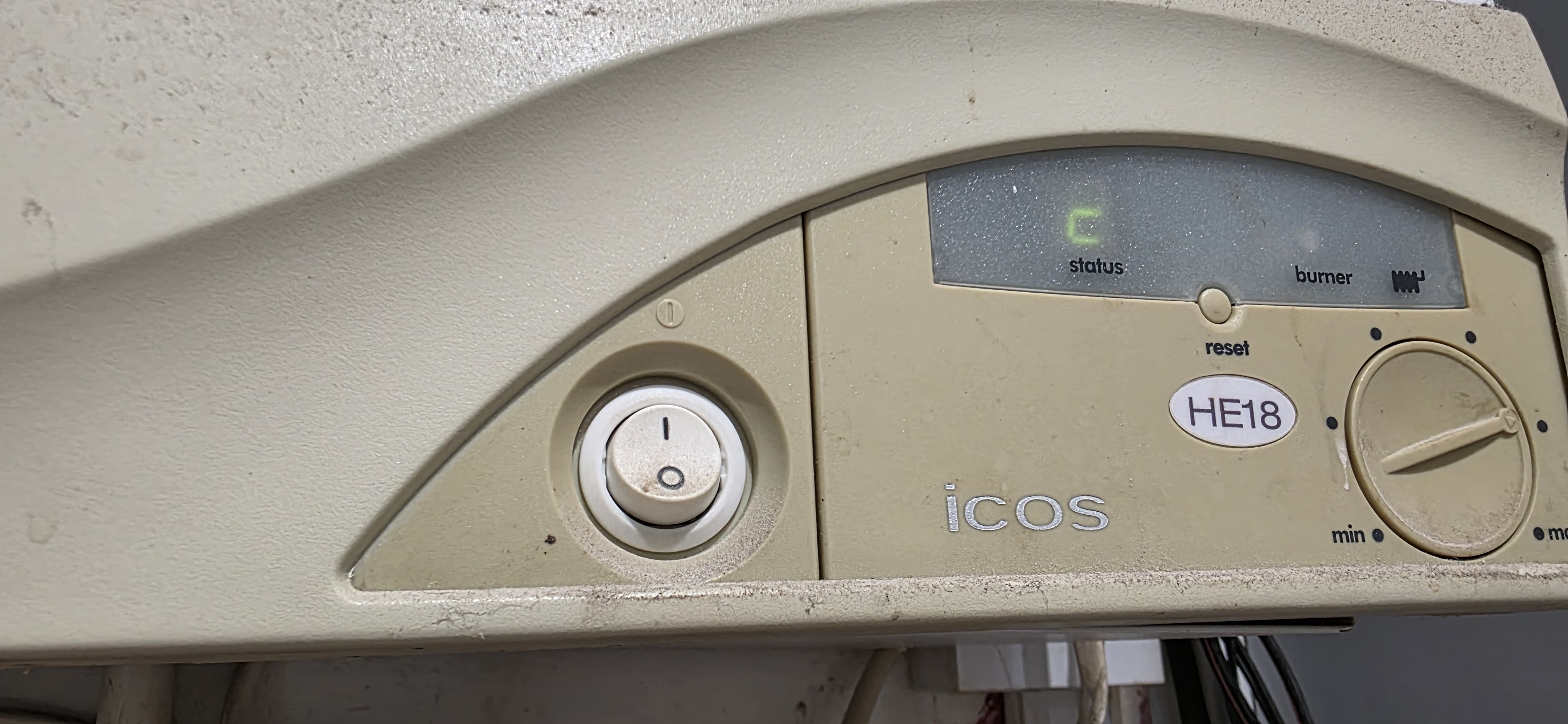
Boiler Fault Codes Explained: What They Mean and When to Call an Engineer
Why your boiler keeps losing pressure (and when to call a Gas Safe engineer in Croydon)
